Posts

Showing posts with the label English Language Arts

Rubrics as Gradeless Feedback Guides

Image
With an organized list of conflated standards and associated learning targets —along with a system for reporting in the gradebook —I now turn to rubrics. However, in a gradeless classroom, I found “rubric” to feel inadequate as a title, since we’re not specifically placing students on a scale. I’ve opted for the title “Feedback Guide.” This will also work into students’ weekly reflections and five-week (mid-quarter and quarterly) reflections and grade pitches . FORMER RUBRICS Originally inspired by Jennifer Gonzalez’s (@cultofpedagogy ) single-point rubric , my former standards-based rubrics looked like the following: As I read a student’s work (the above rubric was for a constructed response analyzing mood), I could put an X in the “I can” or the “I cannot yet” column next to each learning target or add more focused feedback in the form of sentences. Then, in the grade column, I’d assign an A, B, C, or F. My original post on this model can be found here . FEEDBACK GUIDES N...
Key Assessments as Course Requirements

With weekly and quarterly reflections throughout our course generally set, I needed to turn my attention to the specifics of assessments. This post, and my next two planned posts, will articulate my current thinking. This post will briefly discuss key assessments, while my next two will explore how I plan to set up my gradebook (we use Infinite Campus) and set up my rubrics for feedback. KEY ASSESSMENTS As written, our district curriculum (whose composition I led) has set writing assignments and a cold-reading multiple-choice test (modeled after our state test) for each of our four units in English 9 and 10. Depending on the unit, the writing assignments range from literary analysis paragraphs, to creative writing, to a multiparagraph persuasive composition, to script-writing, to a multiparagraph argumentative piece, to a multiparagraph literary analysis (spread across grades 9 and 10). I plan to label these assignments as “key assessments.” Following Joe Feldman’s (@JoeCFeldma...

Weekly Learning Guides to Organize Student Learning

With Standards and Learning Targets determined and an overarching reflection and organization document for the semester , I needed to turn my attention to organization on a weekly scale. HYBRID SCHOOL PLAN My students are scheduled to return to school on September 8 th . I will see half of each class on Tuesdays and Thursdays and the other half on Wednesdays and Fridays (with Monday being a virtual day for everyone). I do not want to rely on in-person instruction once school begins—especially when students become absent (for any reason). Rather than needing to see a student in-person to “catch them up,” I want everything available online. Then, we can use class time for conferring and community. To this end, I will also be settling on weekly-long explorations/lessons. Each week will include brief instructional videos, readings, an assessment (usually writing), and a reflection. We’ll begin journaling (either in response to literature or as open-writes) early on. Our school util...

Organizing a Learning Reflection Process

Image
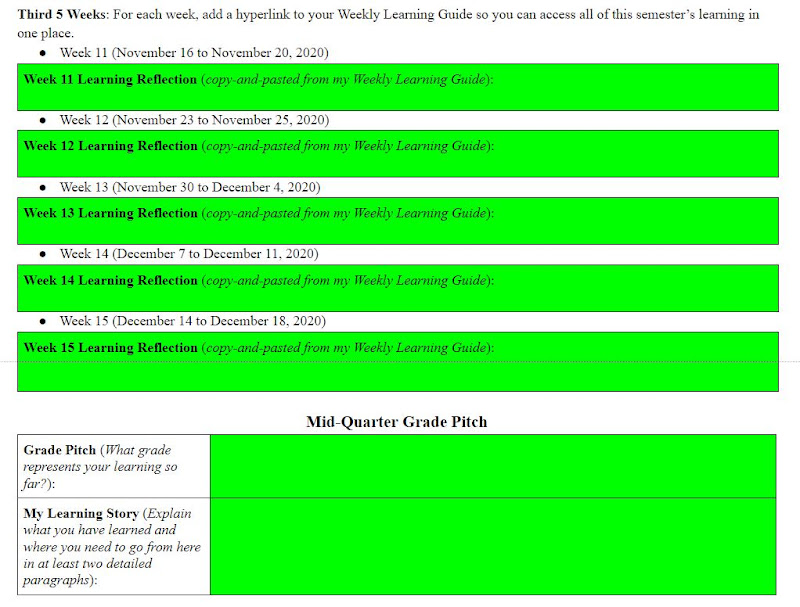
With my English 9 course standards and learning targets decided, I next turned to figuring out how to possibly organize a data collection system that focused on feedback and reflection rather than points. Some of my most recent thinking can be attributed to Sarah Zerwin ( @SarahMZerwin ) and her book Pointless: An English Teacher's Guide to More Meaningful Grading . In the past, I had developed work logs where students could record their reading, journal, and copy the day’s learning target. Last spring, before going virtual, students were tracking their online vocabulary program progress and gathering evidence of their writing style in two additional Google Docs. I wanted to keep many of these organizational options, but I also wanted to ensure that I didn’t have students needing to always open so many documents. WEEKLY LEARNING GUIDES Last spring, for my Honors English 9 class, I created a Google Doc for our two units we explored while at home. For my Academic English 10 cl...

Revising Power Standards in Preparation for Going Gradeless

Two years ago, I began combining and rearranging the English Language Arts content standards that I would utilize in my courses. Since then, I’ve made developments in my assessment practices, and as I prepare to begin on a hybrid schedule this fall and utilizing grade conferences (where students will present evidence of their work and pitch the grade they deserve), I wanted to further refine my work. My plan to is post much more frequently in the coming days and weeks as I articulate my own journey in preparation for the school year (our students begin on September 8 th , 2020). Since my first post on this in August 2018 , I reduced my eight standards to six to make it more manageable. Last school year, I utilized to the following six standards (reduced from the Pennsylvania Core Standards): 1.      Standard 1 : Applying Literary Elements & Devices I can define and apply various elements of fiction (characterization, setting, point of view, conflict, plot, ...

Video Lectures to Assist Students During Workshop

Image
I have finally begun a video lecture series that my students can reference as they write, work, and study. I attended Andrew Easton’s ( @EastonA1 ) 2017 NCTE session on “Genre Exploration through Immersive Game Units.” At the time, I was gamifying my classroom and his presentation was inspiring. However, the piece I most connected with was short video-recorded lessons to help in personalized learning. I knew I at least needed to have video lessons for students to refer back to. Also in the past two years, I read Catlin Tucker’s (@Catlin_Tucker ) blog posts on station rotation models. This post explores the “in-class flip.” It was only earlier this school year that I began recording mini video lectures. Andrew suggested keeping videos to five minutes or less. To capitalize on the rhyme, I decided on “Mr. E in 3” (minutes) as my video series name. I did not do any editing or any real tech work. I pulled up the notes and organizers I utilize in class and delivered my mini-l...

A Year in Review

This obligatory year-in-review blog serves a couple purposes. It serves as a table of contents from the past year, but it also provides some updates on where I currently am with my practice. My blog is meant to record my journey of transforming my teaching practices, so compiling and crafting this current post was helpful to me as I was able to contextualize my journey: it was a lot in one year! A note of clarification as you read on: I teach on an 80-minute, intensified block schedule, so I see my high school students 80 minutes every day for half a school year (and then we switch semesters). Enjoy, and please reach out ( @NAEmmanuele )! 1-7-18 : Writing a Workshop Curriculum . 1-14-18 : (Re)Writing Assessments for Secondary Writing Workshop . I have maintained the workshop and mini-lesson structure elaborated upon here. I no longer utilize GrammarFlip (budgetary constraints) and we have shifted from Wordly Wise (for Vocabulary) to Membean.com. I am still ...

Qualifying Proficiency Levels with Look-Fors

Image
As I work to assess my students more appropriate in my workshop environment, I have continually shifted how my rubrics are formatted . After hearing Dr. Connie Moss from Duquesne University ( @DUSchoolofEd ) speak on Learning Targets again at a recent in-service, I began to see how her concept of “student Look-Fors” could better articulate our learning goals in class. “Look-Fors” are the aspects in a learning experience that students can look for in their own work to see if they are on-target to demonstrate their learning. In earlier iterations, I had written Learning Targets with accompanying Performances of Understanding (POU) for each lesson. For example, here is one of my Learning Target and Performance of Understanding from two years ago: I know I can discuss text structure when I categorize examples from the myth of Theseus into the aspects of the Hero’s Journey . The first portion (“ I know I can discuss text structure ”) is the learning target, while the proof (“...

Preparing Standards and Learning Targets for Standards-Based Grading in HS ELA

From Workshop to Standards-Based Scoring After establishing a workshop model last year in my 9 th and 10 th grade English classes, I want to move closer to standards-based grading this year. For me, establishing an instructional model that more closely works with standards-based learning was an important first step. Please refer to this post for a summary. Now, I can continue my exploration. In this blog post, I will walk through the steps I took to establish the eight standards I will assess my students on in Academic English 9: Standard 1 : Analyzing Literary Elements & Devices Standard 2 : Analyzing Nonfiction Elements & Concepts Standard 3 : Evaluating Text Genre, Form, and Structure Standard 4 : Utilizing Evidence & Research Standard 5 : Crafting Focus, Organization, and Style Standard 6 : Composing Narratives Standard 7 : Expanding Vocabulary Standard 8 : Developing Speaking Skills Step 1: Prioritizing Standards Last year, I revi...