Posts

Showing posts with the label standards-based grading

Rubrics as Gradeless Feedback Guides

Image
With an organized list of conflated standards and associated learning targets —along with a system for reporting in the gradebook —I now turn to rubrics. However, in a gradeless classroom, I found “rubric” to feel inadequate as a title, since we’re not specifically placing students on a scale. I’ve opted for the title “Feedback Guide.” This will also work into students’ weekly reflections and five-week (mid-quarter and quarterly) reflections and grade pitches . FORMER RUBRICS Originally inspired by Jennifer Gonzalez’s (@cultofpedagogy ) single-point rubric , my former standards-based rubrics looked like the following: As I read a student’s work (the above rubric was for a constructed response analyzing mood), I could put an X in the “I can” or the “I cannot yet” column next to each learning target or add more focused feedback in the form of sentences. Then, in the grade column, I’d assign an A, B, C, or F. My original post on this model can be found here . FEEDBACK GUIDES N...

Key Assessments as Course Requirements

With weekly and quarterly reflections throughout our course generally set, I needed to turn my attention to the specifics of assessments. This post, and my next two planned posts, will articulate my current thinking. This post will briefly discuss key assessments, while my next two will explore how I plan to set up my gradebook (we use Infinite Campus) and set up my rubrics for feedback. KEY ASSESSMENTS As written, our district curriculum (whose composition I led) has set writing assignments and a cold-reading multiple-choice test (modeled after our state test) for each of our four units in English 9 and 10. Depending on the unit, the writing assignments range from literary analysis paragraphs, to creative writing, to a multiparagraph persuasive composition, to script-writing, to a multiparagraph argumentative piece, to a multiparagraph literary analysis (spread across grades 9 and 10). I plan to label these assignments as “key assessments.” Following Joe Feldman’s (@JoeCFeldma...

Learning Targets and Daily Work Logs

Image
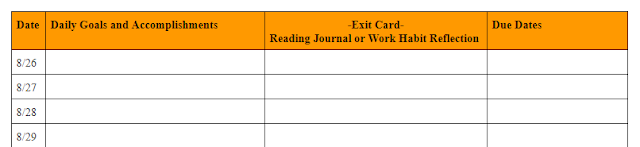
I have been working with the concept of our daily work log for a while now, but I was not implementing it in a way that was truly beneficial. My first iteration asked students to list what they planned to accomplish in a given class period (based on my mini-lesson and assignments). Too often, there wasn’t enough to warrant a list, or teaching how to break down a task into smaller parts was more time-consuming than I had planned (such as breaking down the parts of planning and drafting an analysis paragraph). Also, I was more concerned with working one-on-one during workshop rather than critiquing the work log. Now, I have fine-tuned that process a bit more. I create a Google Doc that I share with all students, and on it, I include the chart above (with as many dates as I estimate a unit of study will take. Then, I create a column for daily reading reflection, another for our daily learning targets, another for a quick check on if students are “on-target,” and a final ...

Teaching Work Habits in the Secondary ELA Classroom

Image
Since implanting a readers-writers workshop, I realized I needed to better help students reflect on their work habits. I enjoyed following discussions online regarding work habits, especially in gradeless or standards-based classrooms where work habits were separate of content mastery reporting. Here is my process and plan to implement the teaching of work habits this year to my sophomore students. GENERATING A LIST I turned to Twitter to seek ideas: What work habits do you try to foster in your Ss? Share ideas with T @NAEmmanuele ! #ProfDev #TeacherEd #SELchat pic.twitter.com/q2MFwKHhpd — Teacher2Teacher (@teacher2teacher) June 10, 2019 With plenty of helpful leads and some ideas percolating, I then came across Mount Desert Island Regional School System’s Middle School Habits of Work Google site. This helped me focus on three habits: respect, responsibility, and perseverance. I edited the last to “work ethic,” and thought I was ready. However, in talking...

Qualifying Proficiency Levels with Look-Fors

Image
As I work to assess my students more appropriate in my workshop environment, I have continually shifted how my rubrics are formatted . After hearing Dr. Connie Moss from Duquesne University ( @DUSchoolofEd ) speak on Learning Targets again at a recent in-service, I began to see how her concept of “student Look-Fors” could better articulate our learning goals in class. “Look-Fors” are the aspects in a learning experience that students can look for in their own work to see if they are on-target to demonstrate their learning. In earlier iterations, I had written Learning Targets with accompanying Performances of Understanding (POU) for each lesson. For example, here is one of my Learning Target and Performance of Understanding from two years ago: I know I can discuss text structure when I categorize examples from the myth of Theseus into the aspects of the Hero’s Journey . The first portion (“ I know I can discuss text structure ”) is the learning target, while the proof (“...

Letting Go of Stories I Love So Students Can Find Stories They Love

As I have shifted to a readers-writers workshop approach and focused more on standards-based learning, I have had to change not just how I teach but what I teach. If students are working more in class (rather than on homework or writing outside of class), I cannot fill an 80-minute block with lecture or group reading. Comprehension questions are no longer necessary as students are working on a lot of independent reading or as they are writing paragraph-length analyses. This has caused me to “lose” some stories and lessons I have enjoyed in the past. But that’s the catch. I enjoyed them. We all know we each appreciate different stories and different concepts. When I opened my class up to choice reading and having students analyze their own texts, I had to provide more class time for this. As others have said more eloquently than me, we must make time for what we value. I want my students to love what they are reading (and, by extension, I want them to love reading), and I want my ...

Constructing Standards-Based Rubrics in the Secondary ELA Classroom

Image
My Instruction and Assessment Philosophy Over the past couple years, I have been reading into standards-based grading and “healthy” grading practices. Along with a variety of blog posts, @TG2Chat/#tg2chat and the #sblchat community, the following resources have assisted me in developing my standards-based assessment (and, in turn, instruction) philosophy: ·          Grading from the Inside Out by Tom Schimmer ( @TomSchimmer ) ·          On Your Mark by Thomas R. Guskey ( @tguskey ) ·          Assessment 3.0 by Mark Barnes ( @markbarnes19 ) ·          Standards-Based Learning in Action by Tom Schimmer ( @TomSchimmer ), Garnet Hillman ( @garnet_hillman ), and Mandy Stalets ( @MandyStalets ) I believe that students must seek learning, not points, and that their grade in my course should be a reflection on tha...