Posts

Showing posts with the label gradeless

Rubrics as Gradeless Feedback Guides

Image
With an organized list of conflated standards and associated learning targets —along with a system for reporting in the gradebook —I now turn to rubrics. However, in a gradeless classroom, I found “rubric” to feel inadequate as a title, since we’re not specifically placing students on a scale. I’ve opted for the title “Feedback Guide.” This will also work into students’ weekly reflections and five-week (mid-quarter and quarterly) reflections and grade pitches . FORMER RUBRICS Originally inspired by Jennifer Gonzalez’s (@cultofpedagogy ) single-point rubric , my former standards-based rubrics looked like the following: As I read a student’s work (the above rubric was for a constructed response analyzing mood), I could put an X in the “I can” or the “I cannot yet” column next to each learning target or add more focused feedback in the form of sentences. Then, in the grade column, I’d assign an A, B, C, or F. My original post on this model can be found here . FEEDBACK GUIDES N...
Key Assessments as Course Requirements

With weekly and quarterly reflections throughout our course generally set, I needed to turn my attention to the specifics of assessments. This post, and my next two planned posts, will articulate my current thinking. This post will briefly discuss key assessments, while my next two will explore how I plan to set up my gradebook (we use Infinite Campus) and set up my rubrics for feedback. KEY ASSESSMENTS As written, our district curriculum (whose composition I led) has set writing assignments and a cold-reading multiple-choice test (modeled after our state test) for each of our four units in English 9 and 10. Depending on the unit, the writing assignments range from literary analysis paragraphs, to creative writing, to a multiparagraph persuasive composition, to script-writing, to a multiparagraph argumentative piece, to a multiparagraph literary analysis (spread across grades 9 and 10). I plan to label these assignments as “key assessments.” Following Joe Feldman’s (@JoeCFeldma...

Organizing a Learning Reflection Process

Image
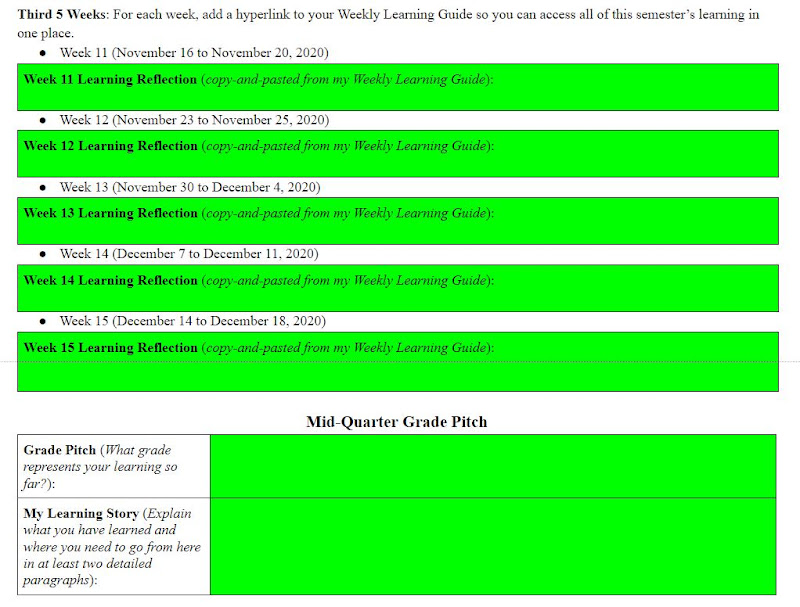
With my English 9 course standards and learning targets decided, I next turned to figuring out how to possibly organize a data collection system that focused on feedback and reflection rather than points. Some of my most recent thinking can be attributed to Sarah Zerwin ( @SarahMZerwin ) and her book Pointless: An English Teacher's Guide to More Meaningful Grading . In the past, I had developed work logs where students could record their reading, journal, and copy the day’s learning target. Last spring, before going virtual, students were tracking their online vocabulary program progress and gathering evidence of their writing style in two additional Google Docs. I wanted to keep many of these organizational options, but I also wanted to ensure that I didn’t have students needing to always open so many documents. WEEKLY LEARNING GUIDES Last spring, for my Honors English 9 class, I created a Google Doc for our two units we explored while at home. For my Academic English 10 cl...