Posts

Showing posts with the label reflection

Gradebook as a Record of Completion

Once I had decided to go gradeless and have students pitch a grade every 5 weeks, I needed to determine how to utilize my gradebook. Students will be reflecting on their learning each week , and I plan to have that Google Doc shared with parents, but I also want to keep our gradebook updated. We utilize Infinite Campus, and I plan to use it to communicate student completion (since feedback will appear in student weekly reflections and in their Weekly Learning Guides ). MY PAST PRACTICE In past years, I divided each assignment into a column for each standard it assessed. So, an analysis paragraph may assess elements of fiction, focus and organization, and use of evidence. There would be three columns for one assignment and would show as “Character Analysis: Fiction Elements,” “Character Analysis: Focus,” and “Character Analysis: Evidence.” I would then assign a letter grade for each standard, provide feedback, and input the letter grade in the gradebook under each category (so a stu...
Key Assessments as Course Requirements

With weekly and quarterly reflections throughout our course generally set, I needed to turn my attention to the specifics of assessments. This post, and my next two planned posts, will articulate my current thinking. This post will briefly discuss key assessments, while my next two will explore how I plan to set up my gradebook (we use Infinite Campus) and set up my rubrics for feedback. KEY ASSESSMENTS As written, our district curriculum (whose composition I led) has set writing assignments and a cold-reading multiple-choice test (modeled after our state test) for each of our four units in English 9 and 10. Depending on the unit, the writing assignments range from literary analysis paragraphs, to creative writing, to a multiparagraph persuasive composition, to script-writing, to a multiparagraph argumentative piece, to a multiparagraph literary analysis (spread across grades 9 and 10). I plan to label these assignments as “key assessments.” Following Joe Feldman’s (@JoeCFeldma...

Weekly Learning Guides to Organize Student Learning

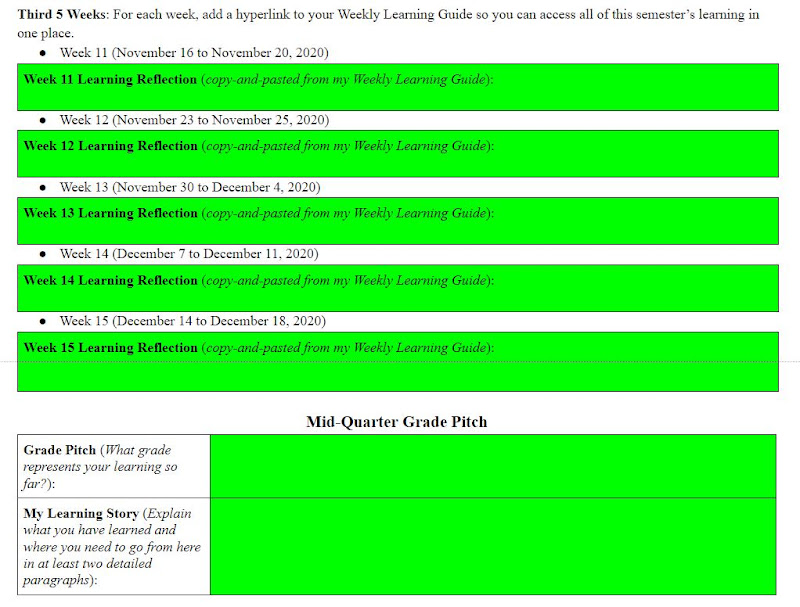
With Standards and Learning Targets determined and an overarching reflection and organization document for the semester , I needed to turn my attention to organization on a weekly scale. HYBRID SCHOOL PLAN My students are scheduled to return to school on September 8 th . I will see half of each class on Tuesdays and Thursdays and the other half on Wednesdays and Fridays (with Monday being a virtual day for everyone). I do not want to rely on in-person instruction once school begins—especially when students become absent (for any reason). Rather than needing to see a student in-person to “catch them up,” I want everything available online. Then, we can use class time for conferring and community. To this end, I will also be settling on weekly-long explorations/lessons. Each week will include brief instructional videos, readings, an assessment (usually writing), and a reflection. We’ll begin journaling (either in response to literature or as open-writes) early on. Our school util...

Organizing a Learning Reflection Process

Image
With my English 9 course standards and learning targets decided, I next turned to figuring out how to possibly organize a data collection system that focused on feedback and reflection rather than points. Some of my most recent thinking can be attributed to Sarah Zerwin ( @SarahMZerwin ) and her book Pointless: An English Teacher's Guide to More Meaningful Grading . In the past, I had developed work logs where students could record their reading, journal, and copy the day’s learning target. Last spring, before going virtual, students were tracking their online vocabulary program progress and gathering evidence of their writing style in two additional Google Docs. I wanted to keep many of these organizational options, but I also wanted to ensure that I didn’t have students needing to always open so many documents. WEEKLY LEARNING GUIDES Last spring, for my Honors English 9 class, I created a Google Doc for our two units we explored while at home. For my Academic English 10 cl...

Developing Learning Targets for Power Standards

[ Revision note, 8/22/20: Shout-out to Hector Caudillo ( @CaudilloHector ) who suggested I rearrange the learning targets of Standard 2 . They have been sequenced so writing a claim comes first, then formatting proper in-text citations, and then using those citations to analyze the topic at-hand. The text below is edited from my original posting .] Continuing from my previous post , I plan to use the following six guiding/power standards for the 2020-2021 school year: Standard 1 : Reading Nonfiction and Informational Texts Standard 2 : Composing Nonfiction Standard 3 : Reading Fiction and Literature Standard 4 : Composing Fiction Standard 5 : Developing Speaking and Listening Skills Standard 6 : Employing Mechanics, Style, and Vocabulary Even from my post a couple days ago , I have changed a category and added Vocabulary back to Standard 6. I was going to have it integrated throughout, but it makes more sense to have one learning target (subcategory) for it under one Stan...

Revising Power Standards in Preparation for Going Gradeless

Two years ago, I began combining and rearranging the English Language Arts content standards that I would utilize in my courses. Since then, I’ve made developments in my assessment practices, and as I prepare to begin on a hybrid schedule this fall and utilizing grade conferences (where students will present evidence of their work and pitch the grade they deserve), I wanted to further refine my work. My plan to is post much more frequently in the coming days and weeks as I articulate my own journey in preparation for the school year (our students begin on September 8 th , 2020). Since my first post on this in August 2018 , I reduced my eight standards to six to make it more manageable. Last school year, I utilized to the following six standards (reduced from the Pennsylvania Core Standards): 1.      Standard 1 : Applying Literary Elements & Devices I can define and apply various elements of fiction (characterization, setting, point of view, conflict, plot, ...

Learning Targets and Daily Work Logs

Image
I have been working with the concept of our daily work log for a while now, but I was not implementing it in a way that was truly beneficial. My first iteration asked students to list what they planned to accomplish in a given class period (based on my mini-lesson and assignments). Too often, there wasn’t enough to warrant a list, or teaching how to break down a task into smaller parts was more time-consuming than I had planned (such as breaking down the parts of planning and drafting an analysis paragraph). Also, I was more concerned with working one-on-one during workshop rather than critiquing the work log. Now, I have fine-tuned that process a bit more. I create a Google Doc that I share with all students, and on it, I include the chart above (with as many dates as I estimate a unit of study will take. Then, I create a column for daily reading reflection, another for our daily learning targets, another for a quick check on if students are “on-target,” and a final ...

A Year in Review

This obligatory year-in-review blog serves a couple purposes. It serves as a table of contents from the past year, but it also provides some updates on where I currently am with my practice. My blog is meant to record my journey of transforming my teaching practices, so compiling and crafting this current post was helpful to me as I was able to contextualize my journey: it was a lot in one year! A note of clarification as you read on: I teach on an 80-minute, intensified block schedule, so I see my high school students 80 minutes every day for half a school year (and then we switch semesters). Enjoy, and please reach out ( @NAEmmanuele )! 1-7-18 : Writing a Workshop Curriculum . 1-14-18 : (Re)Writing Assessments for Secondary Writing Workshop . I have maintained the workshop and mini-lesson structure elaborated upon here. I no longer utilize GrammarFlip (budgetary constraints) and we have shifted from Wordly Wise (for Vocabulary) to Membean.com. I am still ...